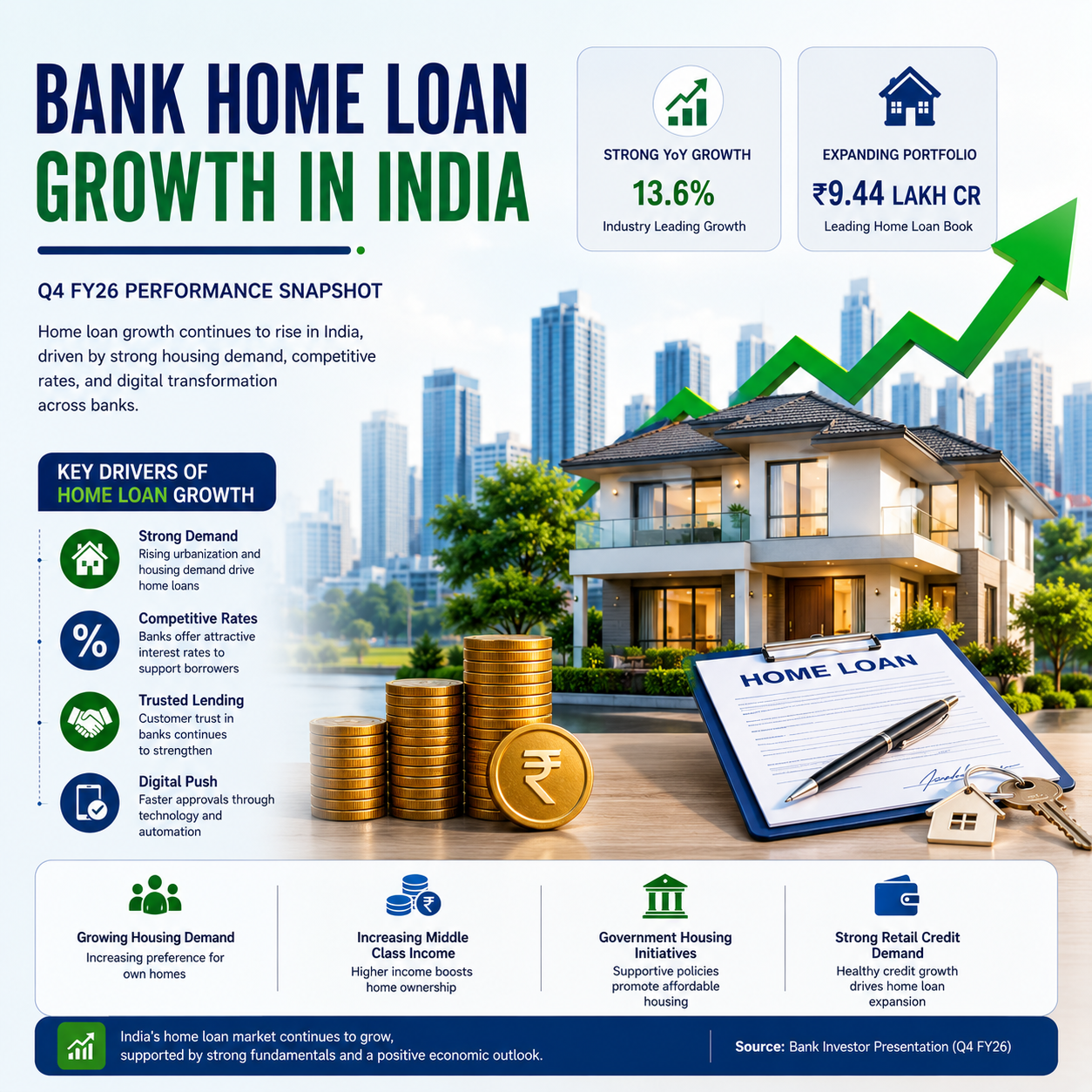
India’s housing finance sector continues to remain one of the strongest pillars of retail banking in FY26. Rising property demand, urban expansion, affordable housing projects, and competitive lending rates are driving steady growth across the home loan industry. However, the latest Q4 FY26 bank investor presentations show that while large banks are aggressively expanding their home loan books, several mid-sized lenders are struggling to maintain momentum.
The biggest winner in the sector continues to be State Bank of India, which holds the largest home loan portfolio in the country with a massive ₹9.44 lakh crore book value and 13.6% year-on-year growth. SBI’s dominance comes from its extensive nationwide branch network, lower funding costs, strong customer trust, and competitive home loan interest rates. The bank continues to benefit from both urban and semi-urban housing demand, making it the market leader in India’s mortgage industry.
Close behind is HDFC Bank with a home loan book of ₹8.88 lakh crore. Although its YoY growth stands at 6.3%, lower than some competitors, HDFC Bank remains one of India’s largest and most trusted housing finance players after its major merger expansion. Its strong retail banking ecosystem and premium customer base continue to support steady long-term growth.
ICICI Bank has also maintained strong performance with 13.2% annual growth and a home loan portfolio worth ₹4.97 lakh crore. The bank’s aggressive digital banking strategy, faster loan approvals, and strong retail customer acquisition have helped it remain one of the fastest-growing private lenders in the housing segment.
Among all major banks, Kotak Mahindra Bank reported one of the highest growth rates at 18%, with a home loan book of ₹1.50 lakh crore. This reflects the bank’s increasing focus on secured retail lending and premium borrowers. Similarly, Bank of Baroda posted healthy 15% growth with a housing loan portfolio of ₹1.50 lakh crore, benefiting from strong public sector trust and competitive pricing.
While large banks continue to grow, some private lenders are moving in the slow lane. Axis Bank reported only 4% growth despite maintaining a sizeable ₹1.73 lakh crore home loan portfolio. Market competition and cautious lending strategies appear to be slowing expansion.
More concerning is the decline reported by several smaller banks. Yes Bank showed negative 1% growth and did not disclose its total home loan book size, indicating continued restructuring challenges. Federal Bank recorded a 1.33% decline with a home loan book of ₹36,128 crore, while RBL Bank posted the sharpest contraction at -2.12% with a relatively small portfolio of ₹5,801 crore.
The gap between large and small lenders is becoming increasingly visible in FY26. Bigger banks enjoy lower funding costs, wider branch networks, stronger digital infrastructure, and higher customer confidence. These advantages allow them to scale faster and offer competitive interest rates. Smaller banks, on the other hand, are facing margin pressure, rising competition, and limited distribution reach.
Despite the uneven performance among lenders, the overall outlook for India’s housing finance market remains positive. Growing urbanization, increasing middle-class income, government housing initiatives, and continued demand for residential real estate are expected to support long-term growth in the home loan sector.
Home Loan Growth Snapshot – Q4 FY26
| Bank | YoY Growth | Home Loan Book Value |
|---|---|---|
| SBI | 13.6% | ₹9.44 lakh crore |
| HDFC Bank | 6.3% | ₹8.88 lakh crore |
| ICICI Bank | 13.2% | ₹4.97 lakh crore |
| Kotak Mahindra Bank | 18.0% | ₹1.50 lakh crore |
| Bank of Baroda | 15.0% | ₹1.50 lakh crore |
| Axis Bank | 4.0% | ₹1.73 lakh crore |
| Yes Bank | -1.0% | Not Disclosed |
| Federal Bank | -1.33% | ₹36,128 crore |
| RBL Bank | -2.12% | ₹5,801 crore |
Source: Bank Investor Presentations – Q4 FY26